The Transition to Autonomous Artificial Intelligence
The landscape of artificial intelligence underwent a profound and structural transformation in the latter half of 2026. For the first several years of the generative artificial intelligence era, the primary mode of human-computer interaction was fundamentally conversational and transactional. A user would provide a text prompt, the system would process the request, and an immediate answer would be generated. However, the release of next-generation frontier models has permanently altered this dynamic. The industry is no longer simply prompting models for immediate text generation; it is assigning complex, long-horizon jobs to autonomous agents capable of planning, executing, verifying, and revising their own work over extended periods.
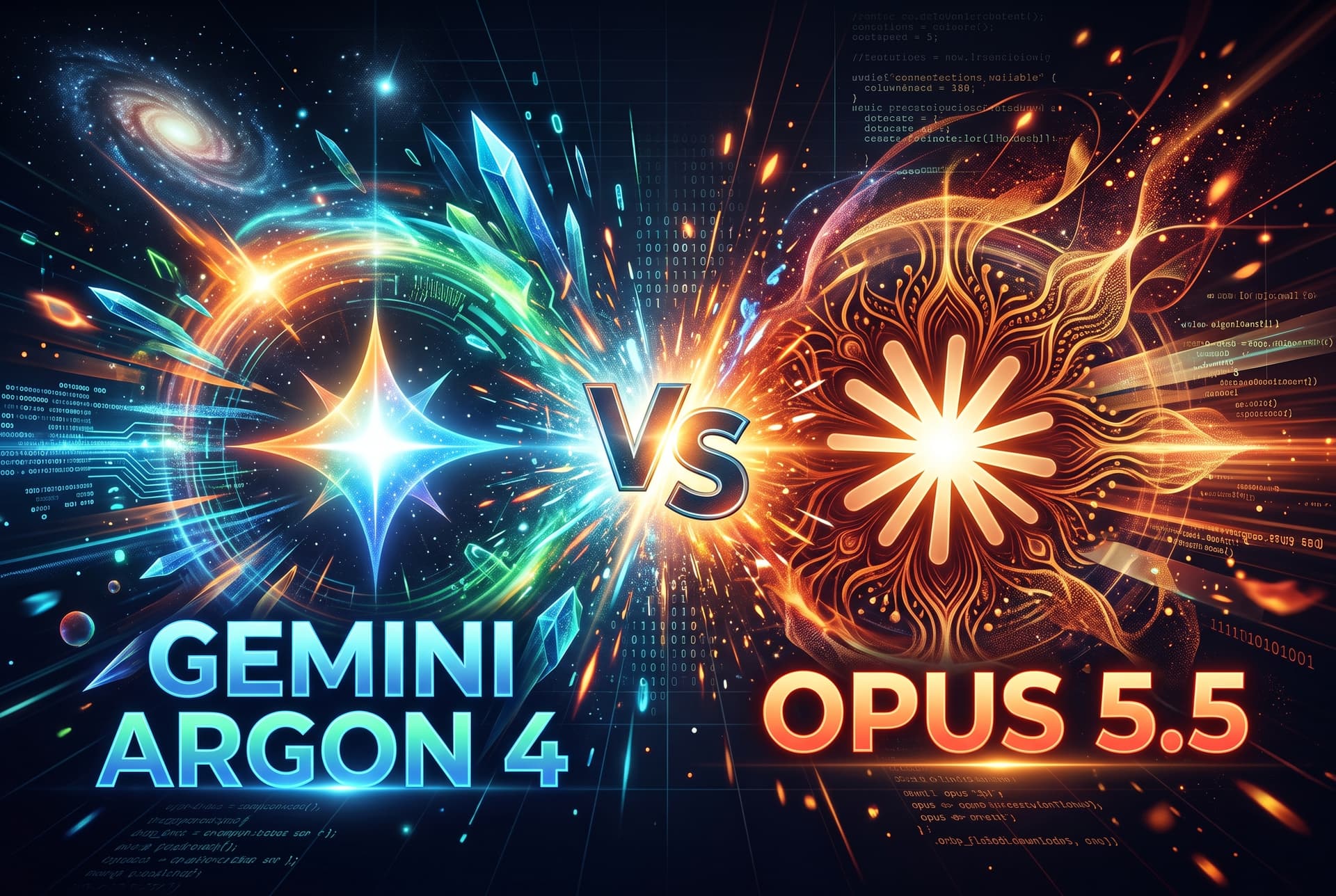
Two of the most significant releases in this new paradigm are Google's Gemini 4 Argon and Anthropic's Claude Opus 5.5. Both models were launched in September 2026, representing the pinnacle of their respective developers' engineering efforts. They are not merely iterative updates to older consumer chatbots; they are highly sophisticated reasoning engines built specifically for deep software engineering, complex legal and financial analysis, cybersecurity defense, and autonomous scientific research.
This document provides an exhaustive analysis of both models. By translating highly technical specifications, benchmark data, pricing economics, and real-world performance metrics into accessible language, this analysis clarifies exactly how these models function mechanically, where they excel in commercial deployments, where their operational limitations lie, and how organizations can best deploy them into production environments.
Architectural Foundations and Design Philosophies
To successfully implement these models into enterprise workflows, it is essential to first understand their underlying architectures and the distinct philosophies that guided their development.
Google Gemini 4 Argon
Announced on September 30, 2026, and rolled out broadly on October 13, 2026, Gemini 4 Argon serves as Google DeepMind's flagship reasoning model and the inaugural entry in the Gemini 4 family. Argon is an entirely new foundation model, distinct from its predecessors; it is not a fine-tuned or modified version of Gemini 3 or 3.5. Google designed Argon with a singular focus on deep, multi-step problem solving, engineering it to maintain focus on highly complex tasks across dozens or even hundreds of sequential steps without losing the thread of the original user intent.
Mechanically, Gemini 4 Argon is built upon a large-scale, sparse mixture-of-experts transformer architecture. In simple terms, rather than activating the entire neural network for every single question, a mixture-of-experts model routes a query only to the specific internal sub-networks—the "experts"—that are best equipped to handle that specific topic. This architecture allows the model to possess a vast amount of total knowledge while remaining computationally efficient during standard operations. Furthermore, Argon is natively multimodal from the ground up. This means the model was trained simultaneously on text strings, image files, audio recordings, and video clips, allowing it to understand the relationships between different types of media intrinsically, rather than relying on secondary translation software.
Google initially restricted access to Argon, releasing it exclusively to a cohort of trusted cybersecurity professionals through a highly controlled initiative known as the Fairwind Program. This phased, cautious rollout allowed Google DeepMind to monitor how the model handled high-stakes vulnerability patching, adversarial attacks, and potential abuse before opening the system to the wider public. Today, Argon is globally available to developers via the Gemini API, Google AI Studio, and Google Antigravity, as well as to everyday consumers and enterprise professionals through Google's premium subscription tiers.
While Argon can ingest almost any form of media, its output is strictly limited to text. The model itself will not generate new images or speak audio responses directly; it relies instead on pairing with other specialized tools within the Google ecosystem, such as the Gemini Omni video generator or the Lyria music model, to handle media creation.
Anthropic Claude Opus 5.5
Anthropic released Claude Opus 5.5 a week prior to Argon, on September 22, 2026. It arrived as the premier model in the new Claude 5.5 family, succeeding the highly regarded Claude Opus 5 and acting as the flagship counterpart to the lighter, faster Claude Sonnet 5.5. Anthropic has consistently positioned the "Opus" tier as its heaviest, most intelligent offering, designed for tasks where precision and deep reasoning are prioritized over raw speed.
Claude Opus 5.5 was engineered with a very specific market objective: to make elite, agentic coding and complex knowledge work significantly more affordable and efficient. Built upon a proprietary transformer architecture, Anthropic asserts that Opus 5.5 performs at the same level as its massive, highly expensive Claude Fable 5.1 model on most professional tasks, but it is specifically engineered to be 40% cheaper to operate than the older Opus 5 model.
Like Argon, Opus 5.5 is designed to function as an enterprise daily driver—an autonomous digital colleague capable of orchestrating complex multi-tool tasks, coordinating secondary sub-agents, utilizing software tools, and driving long-running projects forward with minimal human oversight. Opus 5.5 accepts text and image inputs and produces text outputs. While it does not natively process audio and video in the same integrated manner as Argon, its dominance in raw text reasoning, coding execution, and logical structuring makes it a formidable asset for software developers and corporate knowledge workers.
Context Windows and Output Capabilities
The most critical specifications for evaluating these new artificial intelligence models revolve around their "context windows"—the amount of data they can hold in their active working memory—and their output limits—how much data they can produce in a single unbroken response.
The Million-Token Information Capacity
Both Gemini 4 Argon and Claude Opus 5.5 feature a massive 1-million-token context window. To conceptualize this, a "token" is roughly equivalent to a piece of a word or a short syllable. A 1-million-token window means the model can hold approximately 750,000 words of information in its active memory at any given time. This volume of data is equivalent to the text of several thick novels, an entire semester of college lecture notes, a massive folder of corporate legal contracts, or a sprawling software codebase containing thousands of distinct files.
The ability to ingest this much information simultaneously fundamentally changes how digital work is executed. Instead of asking a model to write a short, isolated function of code, a software engineer can upload their entire software repository and instruct the model to find a bug hidden deep within the interactions of dozens of different files. A legal professional can upload hundreds of pages of dense case law and ask the model to extract specific, highly contextual legal precedents without losing track of the overarching narrative.
Output Boundaries and Long Decoding Mechanics
While both models can read a massive amount of data, they differ mechanically in how they handle the generation of new text.
Claude Opus 5.5 features a maximum synchronous output limit of 128,000 tokens. This means it can write about 100,000 words in one continuous response. For the vast majority of human applications—such as writing analytical reports, generating code scripts, or summarizing financial data—this is more than sufficient. For highly specialized, high-volume automated tasks that require even larger outputs, Anthropic allows users to extend this limit to 300,000 tokens by utilizing its Batch API, which processes requests asynchronously in the background at a lower priority.
Gemini 4 Argon handles input and output tracking through a different mechanism known as a "unified" 1-million-token limit. This means the model's reading space, its internal "thinking" space, and its final written output must all share the exact same 1-million-token bucket. By default, Google caps Argon's output at 65,536 tokens to prevent runaway computational costs and unnecessarily long responses. However, developers can opt into a feature called "long decode." By changing a simple configuration setting to run the task in the background, Argon can generate output all the way up to the 1-million-token limit, subtracting whatever tokens were already consumed by the input and the internal reasoning process. This allows Argon to return complete, multi-file software rewrites or massive, long-form mathematical proofs in a single, unbroken pass, provided the user configures the system correctly.
Temporal Knowledge Cutoffs
Because these models are trained on vast datasets captured at a specific point in time, they do not inherently know about events that occurred after their core training phase was completed.
Claude Opus 5.5 possesses a knowledge cutoff of June 2026. Gemini 4 Argon operates with a slightly older cutoff of March 2026. For historical research, coding in established programming languages, or analyzing provided documents, these cutoff dates are irrelevant. However, if a user queries either model regarding breaking news, recent political events, or brand-new software updates released in late 2026, the models will not possess the answer internally. To bridge this gap, both models must be explicitly paired with live web-search grounding tools, allowing them to fetch current information before formulating a response.
The Evolution of Artificial Intelligence Reasoning
Perhaps the most radical architectural shift introduced by this specific generation of models is the concept of transparent, scalable "thinking." Previously, a model would simply predict the next logical word in a sequence as rapidly as possible. Now, models are explicitly designed to pause, reason, plan, and verify their logic internally before they begin typing their final answer to the user.
Tunable Reasoning in Gemini 4 Argon
Google has equipped Gemini 4 Argon with a user-tunable thinking level. Developers can set the model's reasoning effort to "low," "medium," or "high" depending on the complexity of the request.
If a user asks Argon a simple, straightforward question, setting the thinking to "low" saves computational money, reduces processing time, and provides a quick answer. However, for a highly complex task—such as patching a severe cybersecurity vulnerability across a sprawling network, or designing the architecture for a new multi-tenant database—the user can set the thinking to "high". This instructs Argon to maximize its reasoning depth. The model will deliberately spend a significant portion of its total token budget silently exploring different solutions, checking its own mathematics, and planning a sequential multi-step approach before it finally outputs the completed work.
Mandatory Adaptive Thinking in Claude Opus 5.5
Anthropic implemented a structurally different approach with Claude Opus 5.5, introducing a mechanic called "adaptive thinking". In a major breaking change from older versions of the Claude family, adaptive thinking is permanently enabled in Opus 5.5; it cannot be disabled under any circumstances.
Similar to Argon, Opus 5.5 allows users to control the depth of this background reasoning using an "effort parameter," which can be configured to low, medium, or high, with the system defaulting to medium. Because the thinking mechanism cannot be turned off entirely, every single API request made to Opus 5.5 incurs the cost and latency of at least a low level of background reasoning. This architectural choice raises the minimum financial cost and response time for trivial, everyday calls, but it ensures that the model rarely makes careless logical errors on simple tasks. The model essentially refuses to operate without verifying its own logic first.
Additionally, Anthropic introduced another strict breaking change regarding tool usage. Opus 5.5 no longer supports forced tool selection; the system only accepts automated tool choice or no tools at all, requiring developers who previously relied on forcing the AI to use a specific software tool to redesign their deployment pipelines.
Comprehensive Economic and Pricing Analysis
Understanding the raw financial cost of artificial intelligence is critical for businesses looking to automate their workflows at scale. Pricing is universally calculated per one million tokens processed. Because models read input data much faster and more easily than they generate new output text, input tokens are consistently priced lower than output tokens.
Standard Token Pricing Metrics
On standard pricing sheets, the baseline rates for both models are perfectly matched:
| Pricing Metric | Gemini 4 Argon | Claude Opus 5.5 |
|---|---|---|
| Input Cost (per 1M tokens) | $4.00 | $4.00 |
| Output Cost (per 1M tokens) | $20.00 | $20.00 |
Data sourced from official vendor pricing documentation.
However, Google is heavily subsidizing Gemini 4 Argon to encourage rapid enterprise adoption. Through November 30, 2026, Argon is available at a promotional introductory price of just $2.00 per million input tokens and $10.00 per million output tokens—exactly half of its standard rate. While this makes Argon highly economical in the immediate short term, enterprise architects building long-term software applications are strongly advised to budget based on the standard $4.00 and $20.00 rates, as the introductory window is brief and will automatically double upon expiration.
The Economics of Prompt Caching
The true operational cost of running an artificial intelligence system drops dramatically when developers utilize "prompt caching." If a user uploads a massive, 500-page legal document and asks the model ten different analytical questions about it over the course of an hour, it is highly inefficient and expensive for the model to process all 500 pages from scratch for every single question. Caching allows the system to hold that heavy document in its short-term memory, charging a drastically reduced rate for subsequent reads.
Anthropic has aggressively priced its caching structure for Claude Opus 5.5, offering highly granular control. A standard cache read costs only $0.20 per million tokens. This represents a massive 60% price reduction compared to the older Opus 5 model, making it incredibly cheap for developers who need the model to repeatedly analyze the same large codebases. However, writing to that cache carries a premium. A five-minute cache write costs $5.00 per million tokens, while an extended one-hour cache write costs $8.00 per million tokens.
Google offers a highly automated, less granular caching system. Argon features "implicit caching," which is enabled automatically in the background for any prompt larger than 4,096 tokens. Explicit caching controls are not supported at all on Argon. When Argon hits a cached text, it applies a staggering 95% discount to the standard input token price.
Alternative Processing Modes
Both providers offer alternative processing modes to alter the cost-to-speed ratio. Anthropic provides a Batch API that slashes prices by 50%, bringing the input down to $2.00 and output to $10.00 per million tokens, provided the user does not need an immediate response. Conversely, for users who need maximum speed, Opus 5.5 offers a "Fast Mode" that increases generation speed by up to 2.5 times, but doubles the cost to $8.00 for input and $40.00 for output.
Ultimately, Anthropic asserts that because Opus 5.5 possesses superior reasoning and requires fewer steps to solve a problem than older models, the total operational cost to complete a real-world task has dropped by roughly 40%. This highlights a crucial lesson for businesses: one must evaluate the total cost per successful task, rather than just looking at the raw token price on a spreadsheet. A cheaper model that requires five attempts and constant human correction to complete a coding task will ultimately cost more in compute and labor than a premium model that executes it correctly on the first attempt.
Performance and Benchmark Showdown
To determine which model is truly superior, researchers subject them to grueling standardized evaluations known as benchmarks. However, the data clearly reveals that there is no undisputed, universal champion. Both models excel in entirely different professional arenas, and their utility depends entirely on the specific nature of the workload.
| Benchmark | Focus Area | Gemini 4 Argon | Claude Opus 5.5 | Leading Model |
|---|---|---|---|---|
| DeepSWE v1.1 | Deep Software Engineering | 77.9% | 74.2% | Argon |
| Terminal-Bench 4.0 | Agentic Command-Line Coding | 57.4% | 66.4% | Opus 5.5 |
| Vals Index | Economic & Enterprise Value | 68.9% | 67.0% | Argon |
| AutomationBench | Real Business Workflows | 51.3% | 42.5% | Argon |
| GraphWalks (256k-1M) | Long Context Reasoning | 84.2% | 66.8% | Argon |
| LVBench | Long Video Understanding | 91.7% | 83.7% | Argon |
| Chartography | Visual Chart Reading | 71.6% | 89.0% | Opus 5.5 |
| Humanity's Last Exam | Advanced Multidisciplinary Logic | 57.1% | 67.7% | Opus 5.5 |
| OSWorld 2.0 (offline) | Computer Use and Navigation | 69.2% | 81.8% | Opus 5.5 |
Note: Data derived from officially published vendor tables and independent evaluations.
Software Engineering and Agentic Coding
When analyzing software development capabilities, the results split sharply depending on the methodology of the test.
Gemini 4 Argon excels at massive, repository-level static analysis. On the DeepSWE v1.1 benchmark, which tests a model using long, real-world software issues pulled from actual development platforms, Argon scores an impressive 77.9%, edging out Opus 5.5's 74.2%. This metric indicates that Argon is highly proficient at reading hundreds of files simultaneously, understanding the overarching architecture, and making surgical code changes without breaking the wider system.
However, Claude Opus 5.5 is the undisputed leader of "agentic coding" in dynamic environments. On Terminal-Bench 4.0, which measures how well a model can act like a real developer operating a command-line interface—typing commands, reading error logs, testing outputs, finding errors, and trying alternative approaches—Opus 5.5 scores a massive 66.4%. Argon lags significantly behind at 57.4%. Furthermore, on CursorBench 4.0 and FrontierCode v1.1, both of which measure if an agent's code changes are clean enough to be safely merged into a production system, Opus 5.5 consistently outpaces the competition. For developers who want to give an artificial intelligence agent access to their computer terminal to autonomously debug a broken application, Opus 5.5 is the vastly superior choice.
Enterprise Knowledge Work and Business Operations
In the realm of corporate white-collar work, both models are incredibly capable, but Argon demonstrates a distinct advantage in specific regulated sectors, while Opus 5.5 excels in data collection and visual interpretation.
The Vals Index is a comprehensive benchmark specifically designed to measure a model's economic impact and practical usefulness in finance, legal, and tax workflows. Argon leads this index entirely, scoring 68.9% compared to Opus 5.5's 67.0%. In tests specifically designed to mimic the work of a financial analyst, Argon proves highly adept at pulling structured data from massive, unstructured document dumps, analyzing financial variances, and generating clean, formatted proposal decks.
Furthermore, on Harvey's Legal Agent Benchmark, which tests the ability to navigate case law, identify data privacy violations, and execute corporate mergers and acquisitions research, Argon vastly outperforms competitors. Its ability to maintain citation fidelity across massive PDF documents makes it a powerful tool for law firms, where missing a single clause can result in severe liability.
Conversely, Claude Opus 5.5 shows immense strength in visual data interpretation and large-scale web operations. On the Chartography benchmark, which tests a model's ability to read and analyze complex charts, graphs, and visual dashboards, Opus 5.5 scores a staggering 89.0%, easily beating Argon's 71.6%. Additionally, on Perplexity's WANDR benchmark, which measures an agent's ability to autonomously navigate the web to execute large data collection tasks, Opus 5.5 outperforms its peers while maintaining a lower cost per task. If a business workflow relies heavily on interpreting data visualizations or scraping the internet for market research, Opus 5.5 is the premier choice.
Independent Evaluations and Specialized Domains
Beyond vendor-supplied data, independent platforms like Artificial Analysis provide crucial context regarding how these models perform in the wild. On the overarching Artificial Analysis Intelligence Index, Claude Opus 5.5 achieves an Elo score of 57.6 at maximum effort, ranking significantly higher than Argon, which achieves a score of 52.6.
Opus 5.5 also dominates the OSWorld 2.0 benchmark. This test evaluates how well an artificial intelligence can take control of a computer operating system, move a mouse, click buttons, and navigate standard desktop applications to complete a task. Opus 5.5 achieves an 81.8% partial success rate, proving it is highly capable of driving a computer interface directly, whereas Argon scores just 69.2%.
However, in evaluations demanding long-context reasoning over massive datasets, such as the GraphWalks benchmark (testing data retrieval between 256,000 and 1,000,000 tokens), Argon maintains an 84.2% accuracy rate, completely outpacing Opus 5.5's 66.8%. This cements Argon as the superior tool for analyzing enormous singular files, such as entire books or massive architectural blueprints.
Reliability, Hallucinations, and Safety Guardrails
The most significant persistent flaw in generative artificial intelligence is the "hallucination"—the tendency of a model to confidently present false, fabricated, or mathematically incorrect information as if it were absolute, verified fact. In enterprise and customer-facing environments, a slow answer is an annoyance, but a confidently wrong answer destroys consumer trust and can result in severe financial or legal consequences.
It is in this specific domain that Gemini 4 Argon reveals what may be its most important, yet least flashy, feature: it is highly calibrated to admit when it does not know the answer.
Independent testing organization Artificial Analysis runs a rigorous evaluation called the AA-Omniscience test to measure factual accuracy and hallucination rates in a vacuum. Among all frontier models that answer at least 45% of the test's difficult questions correctly, Gemini 4 Argon possesses the lowest hallucination rate in the entire industry at just 15.1%.
To place this in perspective, competing models have hallucination rates routinely exceeding 50% on the exact same test. While rival models might answer slightly more questions correctly overall, they achieve that volume by aggressively guessing, resulting in roughly 2.4 times as many confident but entirely incorrect answers compared to Argon. Argon is highly procedurally disciplined; when confronted with missing information or a question outside its knowledge base, it is far more likely to explicitly state that it cannot find the answer rather than fabricating a response. For businesses building automated customer support agents or medical data extractors, Argon's extreme honesty makes it a uniquely safe choice for live deployment.
Cybersecurity and Prompt Injection Defenses
Cybersecurity is a massive focus for both models. Anthropic claims that Opus 5.5 is its most secure coding agent to date. On the Gray Swan benchmark, a rigorous test designed by an independent security firm to measure a model's resistance to prompt injection attacks, Opus 5.5 tied for the lowest success rate of any model tested. Prompt injection occurs when malicious text—sometimes hidden invisibly on a webpage or within a document—instructs the artificial intelligence to ignore its safety training and execute a harmful action.
Google matches this focus on security. Argon features deep resistance to indirect prompt injection, with attackers on the Gray Swan benchmark succeeding only 0.7% of the time across 15 highly adaptive attempts. Furthermore, Argon's runtime is strictly monitored; independent systems track the model's internal chain of reasoning and actions. If the model appears to be generating malicious code, aiding in the creation of chemical or biological weapons, or simply deviating from the safe path intended by the user, the monitor will immediately halt the execution.
Google has also refined its safety tuning between model generations. Argon refuses fewer legitimate requests than its predecessor, with unjustified safety refusals dropping by 9.6 percentage points, meaning users will experience less friction when asking the model to perform benign tasks. Additionally, Google improved the tone of the model's refusals by 5.5%, ensuring that when the model does refuse a dangerous prompt, it does so in a neutral, objective manner rather than a preachy or condescending tone. However, automated multilingual safety evaluations did see a slight decrease of 3.16 percentage points, indicating that safety guardrails may be slightly less robust when interacting with the model in languages other than English.
Communication Style and Creative Tone
Raw intelligence and coding ability are vital, but how a model communicates with its human users greatly impacts its everyday usability. Here, the two models exhibit drastically different "personalities" and tonal approaches.
Google notes that Argon has been deliberately tuned to communicate more clearly and procedurally than previous Gemini models. It is designed to answer questions directly, avoid tired corporate clichés, and resist the urge to repeat itself unnecessarily in long responses. It excels at following strict rubrics and checklists to the letter, making it an excellent robotic administrator.
However, users, researchers, and creative professionals consistently point to Claude Opus 5.5 as the vastly superior model for creative writing, nuance, and conversational flow. Anthropic has explicitly trained Opus 5.5 to write like a "good colleague". It strips away unnecessary jargon, gets straight to the point, and strictly follows custom style guidelines provided by the user.
In creative writing tasks, Opus 5.5 demonstrates a much better grasp of emotional resonance, narrative structure, and empathy. On the Artificial Analysis Design Arena specifically measuring creative writing, Opus 5.5 routinely outranks Argon by a significant margin. For authors, copywriters, or marketing teams looking for an artificial intelligence partner to help draft emotionally engaging content, Opus 5.5 feels less like a machine and more like a talented human collaborator.
Physical World Understanding and Robotics Integration
While large language models are primarily utilized through chat interfaces or integrated into software backends, they are increasingly serving as the primary "brains" for physical robots operating in the real world. Google has pushed Gemini 4 Argon aggressively into this physical space, leveraging its multimodal roots.
Argon features an incredible leap in physical, spatial, and visual-semantic reasoning. On the Embodied Reasoning (ERQA) benchmark, which specifically tests a model's ability to understand and solve physical, spatial problems in 3D environments using pure reasoning, Argon scores a dominant 87%, outperforming all other frontier models.
Google DeepMind has demonstrated Argon's capabilities across the entire robotics lifecycle. One of its most powerful applications is "Real2Sim," the process of translating real-world events into digital simulations. For example, Argon can watch an egocentric video of a human performing a complex manipulation task. It will automatically identify the relevant objects, replace crude tracking boxes with highly accurate 3D meshes, and retarget the human's hand trajectory onto a digital 76-degree-of-freedom bimanual humanoid operating in a physics simulator. Furthermore, developers can simply show Argon a crude pen-and-paper sketch of an Apollo 2 humanoid throwing a ball to knock over stacked boxes, and Argon will automatically write the code to construct the GPU-accelerated simulation scene and synthesize the required robotic motions.
In a practical demonstration of physical control, Argon was utilized to control a Boston Dynamics Spot quadruped robot. The model first built a digital twin of a foot-pedal trash bin in a simulation environment called MuJoCo. It practiced the physics of stepping on the pedal and dropping a soda can into the bin millions of times in the simulation. Once it perfected the physical movements digitally, it transferred that knowledge seamlessly to the real-world robot, allowing the physical machine to perform the task flawlessly.
Argon is also highly proficient at "hindsight labeling." Given an overhead video of a bimanual ALOHA 2 robot folding a square sheet of paper into an origami fox, Argon can analyze the 136-second video and automatically produce a highly detailed, time-aligned annotation hierarchy, identifying the overarching goal, subtasks, atomic contact primitives, and even grading the quality of the robot's grasps.
While it is important to note that Argon's public API is not currently fast enough to serve as an unmediated, millisecond-by-millisecond motor controller for live robotics, it serves as a brilliant high-level planner, simulator, and data labeler, proving that artificial intelligence models are rapidly breaking out of digital screens and into the physical world.
Enterprise Workflows and Real-World Impact
Both Google and Anthropic have focused heavily on proving that these models can execute actual, valuable work for massive corporations at scale.
Code Refactoring at Google Scale
Google trusted Argon to work on one of its most complex internal products: the Chrome web browser. The Chromium codebase consists of roughly 40 million lines of code. Google engineers needed to separate the core webpage handling logic from a massive, 6-million-line folder of legacy browser features.
Using Argon, the team automated the untangling of these interwoven files. Argon piped clean code changes across hundreds of interconnected files simultaneously. What would typically have been a grueling, highly error-prone project lasting many months was completed in just a few weeks. This refactor directly prevents a specific category of browser crashes, meaning Argon's code is now actively improving the daily experience of billions of global internet users.
In another internal deployment, fleets of Argon agents were tasked with analyzing profiling telemetry data across Google's massive data centers. Operating autonomously, these agents identified profound memory inefficiencies and wrote code to optimize them, freeing up over 300 Terabytes (TiB) of memory upon rollout, with an estimated total savings approaching one Petabyte (PiB). Argon was also used to optimize a memory-safe Rust video decoder, resulting in a system that runs 2.7 times faster than the previous version.
Agentic Migrations with Claude Opus 5.5
Anthropic boasts similar real-world engineering feats for Opus 5.5. Because Opus 5.5 is designed to operate autonomously over long horizons, it excels at massive, tedious migrations. Anthropic reports that an early tester utilized Opus 5.5 to complete a software migration involving roughly 680,000 lines of code in less than a single day. This exemplifies the shift in the nature of artificial intelligence work: developers are no longer asking models to "write this function," but rather "migrate this entire database architecture and fix the resulting errors until it compiles".
Global Access, Platforms, and Subscriptions
The method by which users and organizations interact with these models heavily influences their ultimate utility and adoption rate.
Anthropic provides access to Claude Opus 5.5 through its own API platform, as well as through major enterprise cloud providers like Amazon Bedrock, Google Vertex AI, and Microsoft Foundry. This multi-cloud availability makes it incredibly seamless for large enterprises to integrate Opus 5.5 into their existing digital infrastructure without having to undergo costly cloud provider migrations.
Google has integrated Gemini 4 Argon deeply into its own vertically integrated ecosystem. Developers can access it through Google AI Studio and the Gemini API. For specialized agentic workflows, Google offers a platform called Google Antigravity. Antigravity provides a hosted sandbox environment where Argon can safely search the web, execute code, verify its own work, and run in continuous loops without risking the user's local computer systems.
For everyday consumers, students, and professionals, Google provides access to Argon through its Google One AI subscription plans, which are bundled with broad ecosystem integrations. Depending on the tier, subscribers gain access to Gemini features integrated directly into Gmail, Google Docs, and Google Sheets, allowing the model to proofread emails and draft documents natively. The subscription also enables "auto browse" in Chrome, allowing the AI to autonomously navigate the web to compare products or book travel, and upgrades Android Auto to allow for complex, conversational tasks while driving.
A Case Study: Accessibility and Pricing in Pakistan
Taking Pakistan as a representative global market, users can access these frontier models without needing enterprise-level budgets, highlighting the rapid democratization of advanced artificial intelligence.
Through the Gemini app, users in Pakistan can subscribe to the Google AI Pro plan for Rs. 5,600 per month. This tier provides full access to the Gemini 3.1 Pro model, the massive 1-million-token context window, Deep Research tools, and 5 Terabytes of cloud storage spanning Gmail, Drive, and Photos. Crucially, this Rs. 5,600 plan grants expanded access to the flagship Gemini 4 Argon model for complex workflows, making frontier intelligence highly affordable for local students and professionals. A lower tier, Google AI Plus, is available for Rs. 1,400 per month, offering increased usage limits over the free tier and 400GB of storage, though it lacks the massive context window required for heavy analytical work.
For heavier users, such as independent developers running autonomous coding agents or creators generating vast amounts of video media, Google offers the AI Ultra plan. In Pakistan, this ranges from Rs. 21,999 to Rs. 55,900 per month, depending on the desired usage limits (offering 5x to 20x the computational quota of the Pro plan). The Ultra tier provides the absolute highest limits for Argon, prioritized server traffic to ensure fast responses during peak hours, access to the Jules coding agent, and massive cloud storage allotments starting at 20 Terabytes.
Similarly, developers and businesses in Pakistan can easily access Anthropic's API utilizing standard credit card billing to integrate Claude Opus 5.5 directly into local software projects. They pay exactly the same $4.00 and $20.00 per million token rate as developers globally, ensuring that geographic location is no longer a barrier to utilizing state-of-the-art reasoning engines.
The Paradigm Shift: From Chat to Autonomous Agency
The most crucial overarching takeaway from analyzing the capabilities of Gemini 4 Argon and Claude Opus 5.5 is that the fundamental nature of interacting with artificial intelligence has changed.
In previous years, if a developer wanted an artificial intelligence to build a functional booking website, they would have to prompt the model step-by-step: first asking for the HTML layout, then prompting again for the CSS styling, then prompting again for the JavaScript logic, and manually stitching the files together.
Models like Argon and Opus 5.5 are designed to operate autonomously in loops. The new workflow requires the human user to act more like a project manager than a typist. A user defines the final goal (e.g., "Build a working, responsive booking website for a pottery workshop"), provides access to the necessary tools and testing environments, and steps back.
The model will then independently investigate the requirements, write a project plan, draft the code, execute the code in a sandbox, read the resulting error logs if the code fails, write a fix, re-test the code, and continue this loop until the final product works perfectly. It is this distinct transition—from single-turn prompts to long-horizon, autonomous, self-verifying agency—that makes Argon and Opus 5.5 true frontier models.
Conclusions and Strategic Recommendations
Both Gemini 4 Argon and Claude Opus 5.5 represent monumental engineering leaps in artificial intelligence, but they cater to slightly different profiles of work. Deciding between them should not be based on a single generic benchmark score, but rather on the specific architectural requirements of the task at hand.
Strategic Deployments for Claude Opus 5.5
Organizations, developers, and creative professionals should route their workloads to Claude Opus 5.5 when:
The task relies on command-line terminal operations. Opus 5.5 is vastly superior at operating as an agentic software developer within a raw computer environment, navigating operating systems, and fixing complex code dynamically.
Creative writing and conversational tone are paramount. For drafting marketing materials, writing consumer-facing documentation, or creating engaging narrative text, Opus 5.5 provides a far more natural, empathetic, and less robotic tone.
Visual chart interpretation and data gathering are required. Opus 5.5 significantly outperforms Argon in analyzing complex data visualizations, reading charts, and autonomously scraping the web for large-scale data collection.
Budget optimization through repeated data reading is critical. For workflows that constantly reference the exact same heavy documents or codebases, Anthropic's $0.20 per million cache read price makes Opus 5.5 highly economical.
Strategic Deployments for Gemini 4 Argon
Organizations and enterprises should deploy Gemini 4 Argon when:
Factual accuracy and low hallucination rates are critical. Argon's industry-leading 15.1% hallucination rate makes it the safest and most honest choice for customer service bots, financial data extraction, and scenarios where confidently wrong answers carry high legal or reputational risks.
The task involves deep, multi-file software repository analysis. Argon's ability to hold context and map relationships across millions of lines of code natively makes it ideal for massive, static refactoring projects.
The workflow is heavily integrated into the Google ecosystem. Argon operates flawlessly alongside Google AI Studio, Google Antigravity, and consumer Workspace tools, providing a seamless experience for teams already utilizing Google infrastructure.
Physical world simulation and robotics are involved. Argon's unmatched spatial reasoning, Real2Sim capabilities, and deep visual-semantic understanding make it the premier choice for hardware engineering, simulation generation, and robotics control logic.
Ultimately, the release of these two models confirms that the artificial intelligence industry has successfully transitioned into the era of autonomous agents. The organizations that thrive in this new technological landscape will be those that stop treating these models as simple conversational chatbots and begin utilizing them as tireless, reasoning digital colleagues capable of executing complex, multi-step projects from inception to completion.